

Revenue feels exciting. Closed deals feel validating. But in the world of high-volume wholesaling, those are lagging indicators. By the time your revenue drops, the structural problem usually happened weeks or even months ago.
KPIs (Key Performance Indicators) are your early warning system. If you aren’t tracking the right marketing and sales metrics weekly, you are operating on emotion instead of data. And emotion does not scale.
Why KPI Tracking is Non-Negotiable
Wholesaling is, at its core, a math game. The formula is simple, but the execution is where most fail:
Leads → Conversations → Offers → Contracts → Closings → Revenue
At every stage of this funnel, conversion either strengthens or breaks. If you only look at the final check, you are blind to the “silent killers” in your business:
- Lead quality decay from overused lists.
- Poor follow-up execution by your acquisition team.
- Stale pipeline build-up where money goes to die.
- Underperforming marketing channels that are draining your budget.
The Core Marketing KPIs Every Operator Must Track
To build a predictable machine, you must move beyond “surface-level” numbers. Here are the eight metrics that actually determine the health of your marketing engine.
1. Total Leads Generated
This measures your raw marketing volume. However, “gross leads” is a vanity metric unless segmented. You must track:
- Leads by Channel: (Cold Calling, SMS, PPC, Signal-Based Lists).
- Cost Per Lead (CPL): Is your marketing getting more expensive?
- Source Quality: Which channel produces the highest intent?
2. Lead Activation Rate
How many leads actually turn into a real conversation? If leads are entering your CRM but aren’t being touched consistently, you don’t have a marketing problem — you have an execution problem. This KPI exposes speed-to-lead issues and workflow gaps.
3. Total Dials & Talk Time
- Dials show effort.
- Talk Time shows engagement.
- If dials are high but talk time is low, your lists are likely poor or your scripts are weak. If talk time is high but offers are low, your team is struggling with qualification or negotiation.
4. Offers Sent
Offers are the bridge to revenue. No offers = no contracts. High-level operators track:
- Offers per rep.
- Offers per 100 leads.
- Weekly offer velocity.
5. Under Contract (The Momentum Indicator)
If contracts are increasing but closings are stagnant, your “back-end” is broken. This suggests weak underwriting, a thin buyers list, or a poor disposition strategy.
6. Closed Deals & Revenue
The final scoreboard. But remember, revenue alone is misleading. To scale, you must calculate Revenue Per Lead and Revenue Per Rep to see who (and what) is actually profitable.
7. Stale Leads (The “Buried Treasure”)
One of the most ignored KPIs. If leads sit untouched for 14+ days, you are losing money you’ve already paid for. Tracking the Revival Rate of these leads often produces the highest ROI in the business.
8. Disposition Movement
A healthy pipeline is a moving pipeline. If leads aren’t changing statuses (dispositions), it means there is no follow-up structure or accountability. A stagnant pipeline is a silent revenue loss.
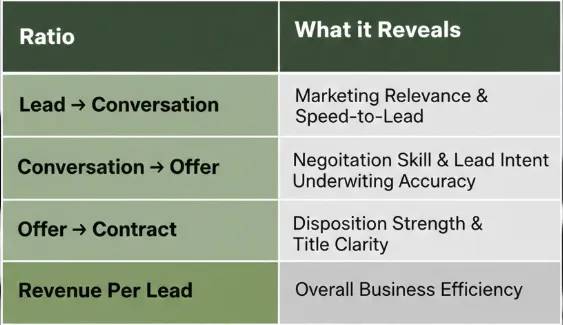
The 5 Ratios That Determine Scalability
If you were stranded on a desert island and could only check five ratios to see if your business was dying, these are they:
How Serious Operators Review the Data
Data is useless if it isn’t reviewed. Elite wholesaling operations follow a strict rhythm:
- Weekly: Review lead volume, activation rates, and offer velocity. Catch the “smoke” before there is a “fire.”
- Monthly: Review Channel ROI and individual Rep performance. This is where you decide where to double down and where to cut.
Final Thought: Clarity Over Micromanagement
KPIs aren’t about breathing down your team’s neck; they are about clarity. When you track lead flow, effort, and movement, you stop reacting to your business and start steering it.
Closer Control was built around this exact philosophy. Real operators don’t rely on luck or morning motivation, they rely on measurable execution. And in this game, measurable execution always wins.